
Submit Your Car: https://www.ZackPradel.com/submit
Contact me!
Email: PradelReviews@Gmail.com
Instagram: @Shooting_Cars
BFB Test Pass/Fail Spreadsheet: https://docs.google.com/spreadsheets/d/1q9-iZ7GiIpvtJT1U1o1IvA67GtMNOIcEuKctIlVfZWM/edit?usp=sharing
DISCLAIMER!
The thoughts, feelings, and opinions expressed in this video are the sole thoughts of Zack and no one else. The thoughts expressed in this video do not reflect the owner, dealership, or organization that owns the vehicle featured. The purpose of this video is to provide entertainment with the hope that you will take what you see and formulate your own opinions. DO NOT make a financial decision based off of this video.
#Škoda #Czechoslovakia



they spent every penny very well.. no power steering or electrical windows. but a vacuum brake enhancher making driving this light weight champion easy.
on crash safety: the front end of the car actually have a very large crumble zone and the rear end an acceptable one. and the cabin is a three rail safety cabin, at that time only found in volvo and saab at a much different price. how do I know that? because my brother totally crashed my fathers favorit at 90 km/h (55 mph). after two rolls it landed on the wheels, interiour cabin absolutely intact. only injury was a bruise from the safety belt.
Around 11:00 you talk about the basic, no-amenities interior, and you are mostly right… but "no radio" – what do you think the little "cubby space" is that you mention at around 04:00? That's where your radio goes! Dunno if the higher trims offered one from the factory but aftermarket radios fitted in that space were a thing well into the early 2000s on most 90s and early 00s models!
Also, I don't know the reason why even today manual is the de facto standard in ICE cars in Europe but in the 90s and before and especially east of the Iron Curtain, automatic transmission barely existed outside maybe premium brands like Mercedes and top models of other brands.
Extra options on the Favorit/Forman (the wagon version) included a handcrank-operated sunroof, which I know because my grandpa had it.
Also, these LPG conversions put a roughly cylindrical tank where the spare wheel would normally go, so carrying a fullsize spare wheel after the conversion means a little less space in the back of the car than you would have in a regular, factory-spec car like the Favorit in the video before it was converted.
Fun fact regarding the engine: this family of engines had been developed in, like, the 50s or something, with continuous improvements at least till the 90s (the Felicia model, developed from the Favorit with VW help, was sold with both this in-house engine and VW-made 1.6L gasoline and 1.9L diesel), though maybe the first-gen Fabia may have used a new generation of this venerable Škoda engine as well.
Might have been nicer if you would have given Škoda trhe credits they earn for developing several prototypes of much more modern cars during the 60/70/80's to get them in production. Having engines up front, they would have changed the brand much earlier than the Favorit did after all in 1987. Why did not Škoda produce these modern successors to the S-100/110 series of cars? Because they were not allowed to. Communist rule is a disaster. Even cooperation with Wartburg and Trabant in the former GDR to have multi-nation modern cars was abolished by stupid leaders in Prague and Berlin. Secondly, the Favorit was designed by Mr Bertone. An Italian with great ideas about how cars should look like. Škoda used his knowledge on car designs to make thing right. First examples of the Favorit had badges with 'Bertone design' on the sides. After VW took over (part of) the Skoda luxury car division they changed the Favorit in several areas and used the term Monomotronic due to its fuel-injection. Interiors became black/blue elements and the general feel was increased. In 1984 Favorit was followed by the Felicia that was much rounder but also had the subframe changed so that VW-engines could also be carried. And thirdly, Favorit not only was offered as 5d hatchback, but also as the roomier FORMAN estate-car, Pickup with several loadbay-coverings and a very handy company-car that could handel 1.5m3 loads. Bertone even designed a Coupe sportscar-version that never made it into production, sorry enough… Škoda is a company that has a great history, dating back far into the 19the Century. They made once super-luxurious cars under license from Hispano-Suiza, which was competitor to Rolls-Royce. They made aircraft-engines, aircraft (D1 fighterplane), trucks, trams, trains, etc. Their greatest problem was to be placed under communist-rule in the 1940's only getting from under that pressure after the Velvet Revolution in 1989. The rest is history. But I guess that without the Favorit, VAG might have decided to buy another company. That story also belongs to the car you described to nicely….Thanks for that.
Great review, especially coming from America. There used to be philosophy in cars and real ethos.
Hank hill would drive a skoda just because it can run on propane.
The Czechoslavikan Made " Skoda Favorite " Superb Hatchback Durable Car & The Czechoslavikan Answer For The Russian Built Legendary " LADA SAMARA " Extremely High Durable Hatchback Cars…… 👍
Favorit may be underpowered but it can be suprisingly quick thanks to being less than 2000lbs and having quite good MacPherson suspension that caused that more you pushed on the front wheels the more grip they got, the car leaned into the corners a lot but if you knew what you are doing (it could almost snap oversteer with the light rear) you would be extremely quick especially on Czech B side twisty tight beatup roads, thats why it won the 2000cc Rally championship with just the 1300cc engine with durability and handling.
A neighbour had a grey estate one and back then it seemed an odd and cheap choice but I have found it to ne above what our național brand Dacia had to offer. Now from your review I see the interior being quite nice and apparently good quality for the price and era. I believe the design aged well, I find it attractive
The trams in Prague are Skodas
Lada Samara model
Wow,,what a beauty!
These really good cars. Even Clarkson loved it.
I have one of these with the pickup body. I have no idea about the milage on it, but it broke on 901k kilometers in 2010. 15 years since then, i've driven it all over Europe, so its definitely done a million at this point.
Nice specimen, brand new. 98 % of drivers had radio in their cars, it just didnt come from the factory, thats what the socket under the ashtray is for. After the communism fell, the "dealerships" offered to install an aftermarket radio as an option, Skodas usually had Blaupunkt back then. The LPG conversion was massively popular, cause gasoline was insanely expensive back then, roughly 7 US dollars per LITRE in todays money, thats some 25 dollars for gallon?
totalitarian regime ended 1989
greetings from Martin / Slovakia 🙂
A very underrated car, with plenty of interior space for a small car
When are you going to drive a Maruri 800:?!
Such a great ergonomics in this little car!
Hi, I’m from the Czech Republic, and as a little boy in the 1990s my dad bought me a book called “Škoda Favorit vyjíždí” (“Škoda Favorit Sets Out”), which described very well how this car was developed. I only really understood it when I was older, but what I’ll never forget is how much the engineers had to struggle with its development. There was a constant shortage of parts and resources, endless persuasion and “under-the-table” actions. The design was even commissioned from the Italians – the Bertone studio. Of course the result had to be heavily modified to fit the possibilities of the time, and the car went into production far too late. But we were still happy to have it – back then it was seen as a very solid and fairly expensive car.
Unfortunately, if it hadn’t been for communism, the Czech Republic would be in a completely different place today. This car wasn’t developed thanks to communism, but in spite of it.
There was a joke told in England. Why are Skoda motors in the back? To keep your hands warm when you're pushing it.
This was my first car ❤ Bought it in 2004 and used it for school. I miss that car.
super prezentace👍
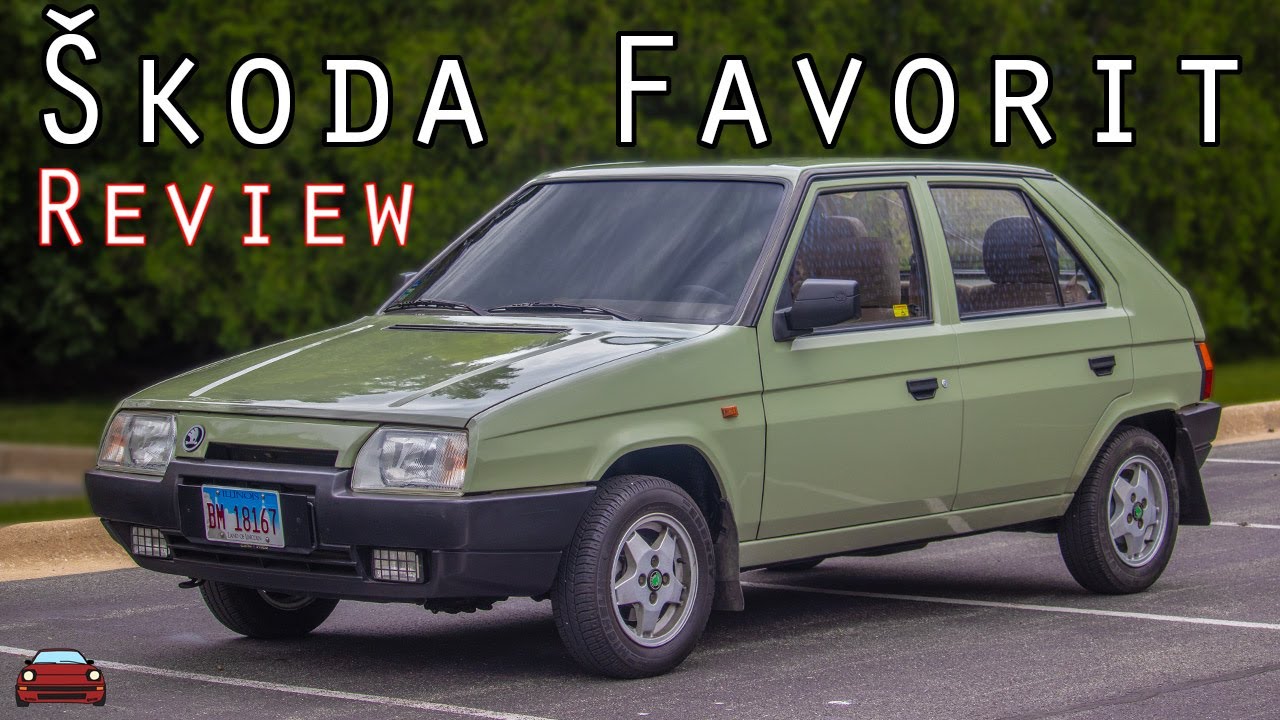
Škoda Favorit have design by Bertone.
That yellow sticker on the front window about the shift lever lock dates the addition of the device quite well. The car on it is a Skoda Fabia (the saloon version), which was built from July 1999. However, the landline number on the sticker still starts with the old area code for Bratislava, 07, which was used only until the end of June 2001, when it was changed to 02 (which is still the same). It also tells that this Favorit was originally bought in the Slovakian half of Czechoslovakia as it's highly unlikely that someone from the Czech Republic would drive to Slovakia to get that thing fitted.
Always loved this early design, with the asymmetrical grill, the Bertone studio did a great job on this one! And the brown squared interior is so '80s, lovely!
Although as far as I've heard, these were very prone to rust, and had numerous mechanical and electrical problems, too… maybe just the early models, and later VW solved most of those, I don't know. Anyway, nice to see such a great survivor in a cool colour!